Camel greeting

Showing posts with label Alevi. Show all posts

Friday, 8 November 2013

Human Rights, Democracy and Islam in Turkey and the Middle East

The longer I live in Turkey the more I come to understand the incredible diversity of this allegedly homogeneous country. One of the first statistics a visitor learns is that Turkey's population is ninety-nine percent Muslim. One of the most quoted sayings of the nation's founder and first President MK Ataturk is the one that goes: ‘How happy is the one who says I am a Turk!’

One face of Islam in Turkey
The official homogeneity, however, masks on-the-ground reality. A superficial indicator of this is the clothing worn by women in Turkey. The wearing of some kind of headscarf is traditional in this part of the world, and you will meet every variation, from the black burka covering all but the eyes, to the brightly coloured silk Armine fashion accessory complementing designer jeans and stylish make-up. Young ladies in the latter category are quite likely to be seen strolling the streets arm-in-arm with a bare-headed mini-skirted female friend, or publicly embracing a male one (probably without a miniskirt). Those women enveloped in black from head to toe are anathema to the secular fashionistas of Nişantaşı and Baghdad Ave, many of whom nonetheless fast during the holy month of Ramazan.

On a deeper level, it is estimated that ten to twenty percent of Turkey's population belongs to the Alevi sect, whose brand of Islam stems from the Shi’ites, one of the two main branches of Islam. Origins of the split date from the early days when the Prophet Mohammed died without making it clear who should take over his leadership role. Turkey's Muslims are predominantly Sunni, but the Alevi group, while maintaining a distinct identity, seems to have little in common with the fundamentalist Shi’ites who hold sway in Iran, or even the Alawi dictatorship of beleaguered Syrian president, Bashar al Assad. Further complicating the matter is the fact that many, though by no means all Alevis are ethnic Kurds, another twenty percent demographic who supported the foundation of the Republic of Turkey, but have resisted cultural and linguistic assimilation.

Apart from these major subsets, the boundaries of the republic contain several other ethnic, linguistic and religious groups: the Laz of the Black Sea region, Arab speakers in the southeast, descendants of Circassian refugees from the Caucasus region. Communities of Armenians and Eastern Orthodox are to be found, their churches and cemeteries occupying prominent sites, especially in Istanbul. Jews remain, still performing rites in the Ladino dialect their ancestors brought from Spain in the 15th century. There is a sprinkling of Catholic and Protestant churches catering, one assumes, to small local congregations, with a little proselytising on the side - and one or two evangelical Christian sects clearly carry out missionary activities.

As a result of the foregoing, there are two conflicting forces at work in modern Turkey. One is the homogenising assimilating process set in motion of necessity by the republican founders back in the 1920s when armed struggle alone would save the land from division, partition and annihilation by the victorious allies after World War One. That struggle could only be initiated by creating a national identity with common roots of history, religion, language and culture, whose owners’ sacred duty was to defend the land on which they stood. Creating and sustaining this identity required a certain amount of myth-making, propaganda and suppression of dissent.

The other force, steadily gaining strength, is one acknowledging the diversity of Turkey's population, and seeking recognition and equal rights for all citizens. Tension between these two forces has been causing conflict such as the so-called ‘Gezi Park’ protests in the early summer. Perhaps surprisingly, far from indicating a failure of democracy in Turkey, this tension is entirely healthy. The democratisation process implemented by Turkey’s government over the past ten years has been slowly granting acceptance and equality to groups previously marginalised. Ironically, this reforming government is the one accused by some citizens of harbouring an ‘Islamist’ agenda - while the protesters are the conservatives supporting military enforcement of exclusive, so-called secular Kemalist values.

On location in Mardin, SE Turkey
I try to keep a finger on what's going on in the world of Turkish soap operas. It's a losing struggle, since there seem to be dozens of them, and they generally run for two years at most. Many of them are obsessed with intrigues in the lives of the rich and famous, showcasing palatial houses in the stratosphere of Istanbul's top-end residential market. While channel-surfing the other day, however, I did come across one that provided a refreshing alternative to the usual fare. ‘Adını Kalbime Yazdım’, (I’ve Written Your Name in My Heart), moved, in the episode I watched, between that Istanbul world of wealth and privilege, and the southeastern city of Mardin near the Syrian border, where the architecture is distinctly Arabic and many of the locals speak Turkish as a second language. The main man, Ömer, a tribal leader, is evidently making a life for himself in the western metropolis, and is engaged to a fashionable young city girl. His mother, however, back in Mardin, has taken it on herself to promise her number one son to the daughter of a rival clan chief, in an attempt to patch up the blood feud that has been seething for years. Our guy speeds back to his hometown to sort things out, but has clearly lost touch with Mardin realities. Rejecting the local girl after agreement has been reached is an unforgivable affront to the honour of both families. His own brother feels obliged to cleanse the sin in the time-honoured tradition - with a bullet.

Recently there was a conference in the Mediterranean coastal city of Antalya: An International Symposium on Children At Risk and In Need of Protection. A press release announced that one in three new brides in Turkey is under eighteen on her wedding day, and that thirty-five percent of these girls are actually ‘second wives’ - understood locally to mean a girl taken by a man in an unofficial ‘religious’ ceremony when he feels he needs a little more excitement than his first wife is providing.

The point I want to make here is that there is more to Turkey than what is common among the secular elite of Istanbul who move from fashionable Etiler, Nişantaşı or Baghdad Avenue to the ski slopes of Uludağ and the beach resorts of Bodrum and Antalya and back, with trips abroad for variety. Undoubtedly the gnomes of Brussels who oversee the European Union are well aware of this, which perhaps explains their reluctance to see Turkey's eighty million people gain free access to their civilised Christian club. It is certainly a better reason than their stated objections to the Cyprus problem, abuse of human rights and police violence against citizens.

As suggested above, a major irony of the Middle East these days (and for our purposes here let's include Turkey by reason of its Muslim identity) is that so-called ‘Islamist’ political parties are often the ones championing human rights, participatory democracy and national sovereignty. ‘Secular’ leaders, in contrast, are more likely to be reactionary, authoritarian and subject to undue influence by foreign powers. This creates difficulties in the minds of ordinary citizens in Western democracies, who are accustomed to associating religion, especially the Muslim religion, with intolerance and backwardness.

Take Iran as an example. Persia has been a land of high civilisation and culture since the dawn of history. This continued until the 18th century when the Great Powers of Europe, especially Britain and Russia, began playing their expansionist games. The games turned to frenzy with the discovery and rise to prominence of oil as the energy to power the 20th century. Anglo-petroleum interests moved in, the Middle East was occupied and divided into ‘spheres of interest’ and ‘mandates’ after the First World War, and a gentleman by the name of Reza Khan emerged from village obscurity and ascended to the throne of Persia with a little help from the Brits. Shah Riza himself apparently offended his erstwhile allies by insisting on Iran’s remaining neutral during the Second World War, and was forced to abdicate in favour of his son, the latter we must assume being more amenable to British Imperial interests. Fifty years passed with exploitation of the country's oil wealth by foreign interests aided and abetted by the local elite who enriched themselves at the expense of the ordinary Persian.

Finally, locals, in 1951, managed to elect a more sympathetic and effective Prime Minister who promptly nationalised the oil industry and encouraged the departure of Mohammed-Reza Shah. The new dawn didn’t last long, however. The British government, keen to protect its own interests but lacking former imperial might, persuaded the new US President Dwight D Eisenhower to get involved. The ensuing CIA-sponsored coup d'etat ousted PM Mossadeq and reinstated the Shah, who restored the status quo and ruled with an iron fist of oppression for twenty-six years until the Islamic revolution led by the Ayatollah Khomeini overturned the puppet monarchy in 1979. Well, I'm not extolling that gentleman's virtues or holding modern Iran up as a model of democratic freedom - but you might want to ask, who is responsible?

Similar case studies can be offered in Iraq and Afghanistan. The United States government supported and armed the Afghan Taliban fighters in their struggle against Russian invasion in the 1980s, then left the country to sort itself out after the Soviets had withdrawn. Saddam Hussein too was initially a useful US ally back then when he sent his military against the demon Iran. Unfortunately, the enemy of my enemy may quickly cease to be my friend, and become my enemy too. Sad to say, the US government seems still not to have learned this lesson. Instead of addressing the root causes of frustration and anger among Middle Eastern populations, President Obama's administration is continuing a policy of unilateral aggression, using its unmanned drones and SEAL commandos to invade the sovereign territory of other states and take out people considered hostile to its interests regardless of collateral casualties and damage to property.

Three examples. In early October, according to an article in Time, the CIA and FBI working with US military forces captured Abu Anas al-Liby, an alleged Al Qaeda leader in Tripoli, Libya. A few weeks later, in apparent retaliation for government complicity, the Libyan Prime Minister was kidnapped at gunpoint by local militia apparently working with ministerial personnel. I was talking to two exchange students from Libya the other day. They were keen to talk and their English was remarkably good. I couldn't resist asking how things are in their country these days. ‘Much better’, said one. ‘Nowadays everyone has a gun. In the old days it was just the police and the soldiers.’

Around the same time as the action in Tripoli, a contingent of SEALs (what a nice innocuous name for a murderous organisation) entered Somalia and inflicted casualties while failing in their objective of capturing or eliminating a leader of another terrorist group, Al Shabab. Just the other day a US drone strike was reported to have killed a Taliban leader in Pakistan, along with anyone else who happened to be in the vicinity at the time.

Successive US administrations supported the military dictatorship of Hosni Mubarak in Egypt for 29 years until he was overthrown by popular demand in 2011. His major appeal in the West was support for Israel, not something Egypt had been noted for in the past. Subsequent elections produced a government with Islamic connections (not altogether surprising in a country whose population is ninety percent Muslim). A military coup in July this year ousted the new democratically elected government and is bringing its leader, Mohammed Morsi, to trial. The US government was conspicuous in its refusal to acknowledge the event as a coup, but more recently has been obliged to take punitive economic measures against the military regime in the face of mounting international criticism of police and military brutality.

A new report by Amnesty International has accused the Egyptian regime of persecuting and rejecting refugees from the ongoing civil war in Syria. Of course it is a major problem for any country to deal with flows of penniless displaced persons from a neighbouring state, but these people are Muslims and fellow Arabs. In contrast Turkey, often the target of criticism by the Amnesty International people, has so far allowed around half a million fleeing Syrians to take refuge within its borders and is doing its best to provide for them. Fortunately the government of Turkey has managed so far to keep the country from descending into the sad state of its Arab neighbours. Anti-government protesters these days seem largely content with pressing the emergency stop button on the new rail link joining European and Asian Istanbul that passes through a chunnel beneath the Bosporus.

I wouldn't, in normal circumstances, look to a blond Hollywood movie starlet for guidance on political matters, but I was interested to see an article about Blake Lively in our local newspaper last weekend. The Turkish journalist had apparently caught up with her in Paris, and they were burbling on about the usual film star stuff - how the poor girl's biggest problem in life is trying not to eat chocolate so that she won't lose her figure. Before finishing, however, the interviewer couldn't resist seeking Ms Lively's opinion about democracy in Turkey and police abuse of human rights. I don't know anything about politics, she said, but I really want to go and see Turkey for myself. The young lady went up considerably in my estimation. Perhaps she could invite that sensitive novelist Paul Auster along when she comes.

Sunday, 27 October 2013

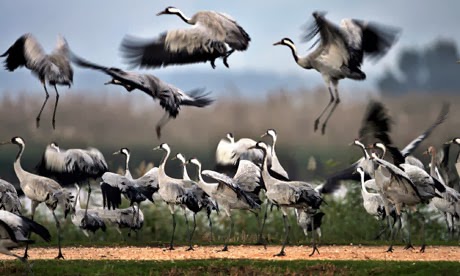
The Anatolian Crane - Symbol and reality


It's great to see a growing environmental awareness in Turkey. Local councils are encouraging residents to sort their garbage and take an interest in the recycling process - and the message is starting to get through. Bicycles are more in evidence on the streets of Istanbul - and not just the cheap supermarket model ridden by children and poor people who can't afford a car. Activists are protesting about the loss of green areas to urban development projects.

Demoiselle cranes -
sacred in religion and symbolic in folklore
All this is laudable, but in any country (excluding Singapore and Monaco perhaps) urban conglomerations make up a small percentage of the total land area. What goes on in those rural areas is arguably of greater importance than what happens in cities. In the end, a city is a place where nature is sacrificed to the needs and comforts of technology and civilisation.

Measured by land area Turkey is the second largest country in Europe, behind only Russia (the largest country in the entire world). Turkey is more than twice the size of Germany, and 30% larger than France. Not surprisingly, then, the empty spaces of Anatolia are home to varieties of plants, birds and animals that have died out in more developed parts of the continent. I came across an article in Today's Zaman, my English language Turkish newspaper, on the subject of the Anatolian, or Demoiselle, crane:

It is not an exaggeration to say that the crane is one of the most prominent symbols of Anatolian culture. If we look only at music, we see the crane appearing in Musa Eroğlu's folk song "Telli turnam selam götür sevgilimin diyarına…" (Oh my crane, carry my love to the lands of my lover…), or even in the group Yeni Türkü's folk song “Telli Turna” (Demoiselle Crane).

Biologist Ferdi Akarsu performed tireless research on these cranes of Anatolia for three years. Interestingly, he came across 45 different folksongs in the Turkish Radio and Television Corporation (TRT) archive that deal with cranes. But are we talking just about folksongs? There are of course also sayings, carpets, hand embroidery and even religious ceremonies that include the crane. The “turna cemi” of the Alevis and the “sema” of the Mevlevis carry suggestions of this bird as well.
So what has happened to our birds? According to field research begun in 2010 by the Nature Association (headed by Akarsu), there are just 12 pairs of breeding Demoiselle Cranes left in Anatolia. The number of juvenile cranes is just 19. This research demonstrates that these cranes are disappearing faster than previously thought.  Read more . . .

Saturday, 19 October 2013

What Would Atatürk Say - if he came back today?


One of the things that impressed me in my first years living and working in Turkey was the seemingly unabashed patriotism in evidence everywhere I looked – pictures of Mustafa Kemal Atatürk, the founder of the Republic in every school classroom and government office; statues of the great man in every public square throughout the land; the national anthem sung with fervour at football matches, public ceremonies and school assemblies; the army held up as the sacred guardian of democracy and secularism; the nation’s flag an object of pride and revered symbol of those who had spilt their blood, even given their lives to establish the Republic of Turkey.

'That watch changed the destiny of a nation'
For me, coming from a country where the gloss of patriotism had been long since tarnished by the lies of scheming politicians, it was a touching experience to be amongst a people so clearly imbued with such loyalty to their nation and belief in the rectitude of their young republic. I remember, in New Zealand, a time when cinema audiences would stand, as the curtain rose, to a stirring performance of ‘God Save our Gracious Queen!’ Younger generations would hardly imagine that such naïveté was ever possible.

That gracious lady was queen, not of New Zealand alone, but of the British Empire, whose star was beginning to fade. The loss of India, embarrassment in Egypt, Iran and Malaya, and the rise to global supremacy of the USA and the USSR, were beginning to push Westminster, London, to the sidelines of world affairs. The threat of nuclear global annihilation, the madness and hypocrisy of the war in Vietnam and a growing awareness of the plight of minority peoples were producing a generation of youth cynical about those in power and not afraid to express their opposition. As New Zealanders remained seated prior to watching the latest exploits of James Bond on cinema screens, the British national anthem was sent happy and glorious to the trashcan of colonial history.

Of course, there are those who may still shed a tear for the passing of a great age, which undoubtedly brought benefits to the world as well as harm. So it is understandable that, in Turkey, there are fears in some circles that abolishing the requirement for primary school students to recite the Oath of Turkishness marks the end of Atatürk’s secular experiment, and clearly demonstrates the anti-republican agenda of the incumbent government. But is it really so?

The secular republic that Mustafa Kemal and his followers established in 1923 was paradoxically overwhelmingly Muslim in the composition of its population. The imperial ambitions and expansion of its northern and western neighbours over two centuries had seen a huge influx to the Anatolian heartland of Muslim refugees expelled from their ancestral homelands, and the encouragement of nationalist secessionist activities within the Ottoman Empire.

When that empire was fighting vainly for its very existence in the First World War, and shortly after its death republican forces expelled foreign armies of occupation, the continued presence of Christian minorities became virtually untenable outside of cosmopolitan Istanbul. The freedom-fighting spirit that Mustafa Kemal harnessed to fight the invaders was a pragmatic coalition of Turkish nationalists, patriotic Ottomans and proud Muslims of many backgrounds. There was a need to unite against a common enemy that inevitably masked differences which later emerged: indigenous groups (Kurds, Laz, Arabs) and refugee immigrants (Circassian, Crimean Tatar, Greek) with their own distinctive languages and cultures; Muslims who did not identify with the Sunni majority (Alevi); Jews and tiny remaining Christian groups, all of whom, to a greater or lesser extent, found themselves obliged to mouth jingoistic slogans of Turkish nationalism with which they felt little affinity.

So the oath that children in schools had been obliged to recite since 1932 has finally been shelved as part of the democratisation package recently introduced by the Turkish parliament. Will that mean the end of secular Turkey? I don’t think so. Mustafa Kemal Atatürk laid down six principles as the foundation stones of his new republic: republicanism, nationalism, secularism, populism, étatism, and reformism/revolutionism. Since his day, the country has been ruled by a ‘secular’ elite. When an elected government strayed too far from the ‘approved’ path, the army could be relied on to step in, remove them and guide the nation back . . . to what?

Nationalism is only one-sixth of those six principles – and to retain its integrity in the long-term, the republic must formulate a definition of ‘nation’ that is inclusive rather than exclusive. Secularism means separation of church (or mosque) and state - it doesn't mean the abolition of religion. The vast majority of Turkey's population is Muslim. All democratically elected governments have to pay lip service to this, and most have done far more. Populism means equality, but you don't have to be long in Turkey to see that there is an unofficial class system lurking not far below the surface, and the military has been intimately bound up with its preservation. Etatism was a mixed economic model that allowed for private enterprise while acknowledging a need for state involvement and oversight – perhaps the ‘Third Way’ that Tony Blah’s New Labour Party in the UK was seeking but never found. Free market capitalists hate it, of course, since it implies state-imposed limits on human greed – and this Kemalist principle fell from favour. What happened to reformism/revolutionism? Successive governments became conservative and used Kemalism/Atatürkçülük as a stick to ensure conformity.

Alongside the statues and pictures of Atatürk you will always find sayings attributed to Turkey’s great founder and leader. Once again, however, there has been a tendency to pick and choose which ones will be remembered and which laid aside. Perhaps the most important of these is the one which goes (freely translated): ‘It is not enough to see my face. The important thing is to understand my ideas and my motives.’[1] Atatürk himself said, ‘There are two Mustafa Kemals: one is the creature of flesh and bone you see before you; the other is the spirit of revolutionary idealism that lives inside all of us.’[2]

Being a true Kemalist, then, is not about hanging his picture on your wall and admiring his steely blue eyes. It does not mean just taking on board the principles that suit your interests and quietly sidelining the others. The words in Atatürk’s Address to Turkish Youth cut two ways - if your fortresses and shipyards are under foreign control it is your duty to rebel and fight. He achieved what he did, founded the republic with vision, determination, popular support and strong leadership. Following him now and in the future means studying his ideas and understanding what he did and why he did it.

For one thing, Atatürk recognised that military victory was only the beginning of the new republic’s struggle. In the long-term, all the achievements of the army would be lost without continued economic development and sharing of prosperity amongst all citizens, not just the privileged few. Leadership does not mean sitting comfortably in your palace enjoying the benefits of civilisation while sending others to do the fighting and the dying. Ataturk won the respect of his people and the right to make hard decisions that not everyone agreed with - including many of the privileged elite - by being a leader who led from the front. He was prepared to put his credibility and life on the line. In the 1915 action known in Turkey as Anafartalar, and to Anzacs as Chunuk Bair, he was at the head of his troops setting an example for others to follow, and the fob watch that stopped a fragment of shrapnel from entering his heart is a powerful symbol of this.

Atatürk is often called the first teacher of the new republic. He emphasised the importance of education for all, and one of the aims of his alphabet reform[3] was to make literacy more accessible. Everyone knows that the education system in Turkey is in desperate need of a makeover. The state system is seriously underfunded, and allowing the private sector to take up the slack is not the answer. It may quieten the privileged minority who can afford to send their children to private schools, but it does not provide quality education. In the end, the main aim of private business is to maximise profits, which, whatever idealistic slogans are propounded by the owners, translates to bums on seats, window-dressing and reducing teacher salaries, which are always the largest item of expenditure.

In recent years the government of Turkey has been pushing ahead with moves to revamp the constitution. These moves have met with considerable resistance from the conservative opposition. From their objections, an outsider might get the impression that the existing constitution was the sacred one written by Atatürk and his brothers-in-arms back in the 1920s – a document akin to the Ten Commandments, set down in stone for all time, infallible and immutable. In fact, the document they so staunchly defend was penned by the generals who carried out the military coup in 1980. It instituted provisions to keep Kurds out of parliament, suppress left wing politics, and used religion and extreme nationalism to gain support for its moves. That constitution is desperately in need of change, but it takes time to carry out serious structural reform in a democratic environment. When criticism comes from both extremes, we may think that the reformers have got it about right. The first necessary change was to pull the teeth of the military who had been the force behind those wishing to retain the status quo. Europe and the US may secretly prefer to deal with dictatorial regimes when doing so simplifies the business of looking after their own interests - but they will never welcome such countries into equal partnership. For Turkey, accepting the result of the ballot box is an important step on the road to establishing a truly democratic republic.

The foreign policy of the government is another area in which Turkey comes in for considerable criticism. On the one hand, it is said that Mr Tayyip Erdoğan’s government is in the pocket of the United States, slavishly doing their bidding like a well-trained lapdog. On the other hand, the accusers assert that Turkey is following a Neo-Ottoman path aimed at undoing secular democratic reforms and restoring Islamic Shariah law. It’s hard to imagine that both accusations can be true – although US friendship with the hand-amputating, woman-flogging Wahhabi extremist Muslim Saudi royal family suggests that they have fewer objections to fundamentalist Islamic dictators than they would have us believe.

Interestingly, the government of Turkey is about to purchase a new rocket defence system from China. The project was put out to tender and the Chinese bid was not only the lowest, but the Chinese also included in the deal an undertaking to share technological expertise, and help Turkey to carry out much of the manufacturing of hardware within its own borders. Tenders from Western nations (and Russia, whose bid was also passed over) did not include such cooperation. Of course, no country, especially one as strategically located as Turkey, can afford the luxury of divorcing itself from the world's only superpower. However this government has proved to those with eyes to see that it is by no means in America's pocket, and is capable of formulating and following its own policies for the good of its own people.

A recent news item announced that New Zealand had been visited by several Chinese warships - I wonder what US leaders think of that. NZ, however, unlike Turkey, is far from the highways of geo-politics and strategy, and like a small child, can count on a little parental indulgence. When NZ's Labour government back in the 70s instituted a ban on nuclear-powered and armed vessels in its waters, the US were naturally peeved, but they lived with it. I wonder if the Chinese vessels currently in Auckland Harbour have nuclear technology on board, or if the Chinese government would let on if they did.

Getting back to Atatürk, he sought and received help from Soviet Russia during Turkey’s War of Liberation. Atatürk was not a Communist but he was a realist. The West would divide and annihilate his country. They were supporting the Greek invasion. If the new Soviet state would aid his struggle, he would accept their aid and deal with the consequences later. As far as I understand, there were none. No doubt Turkey's membership of NATO meant that it had the backing of the US and Western Europe to discourage Soviet incursion during the Cold War - but the West too undoubtedly benefited from Turkey's large military, and from being able to locate bases on Turkish soil. It wasn't a one-way street.

The second decade of the twenty-first century is shaping to be an interesting one for Turkey. The economy continues to show strong signs of good health and growth. Undoubtedly, political problems in the region continue to pose problems, not only locally, but for the world beyond. Turkey is on the spot. It has a long history of dealing with its neighbours, and Western powers would do well to soft-pedal their criticism and lend an ear to what Turkish spokespersons on foreign policy have to say. As for the people of Turkey, I have heard some express a nostalgic wish for a resurrected Atatürk to return to the nation’s helm. It can’t happen, of course – but I suspect that, if he were looking down from somewhere on high, he would not be totally disappointed with the current state of the republic he founded.


[1] Beni görmek demek, mutlaka yüzümü görmek değildir. Benim fikirlerimi, benim duygularımı anlıyorsanız ve hissediyorsanız bu kâfidir.
[2] İki Mustafa Kemal vardır: Biri ben, et ve kemik, geçici Mustafa Kemal... İkinci Mustafa Kemal, onu "ben" kelimesiyle ifade edemem; o, ben değil, bizdir!
[3] Abolishing the Arabic alphabet in favour of a Latin-based one.